China's Inland Shortcut to ASEAN Just Crossed 500 Billion Yuan
The New International Land-Sea Trade Corridor moved a record US$76bn of goods in H1 2026, turning the inland-China-to-ASEAN leg into a costed logistics option.
The New International Land-Sea Trade Corridor moved a record US$76bn of goods in H1 2026 — shortening the China+1 line.
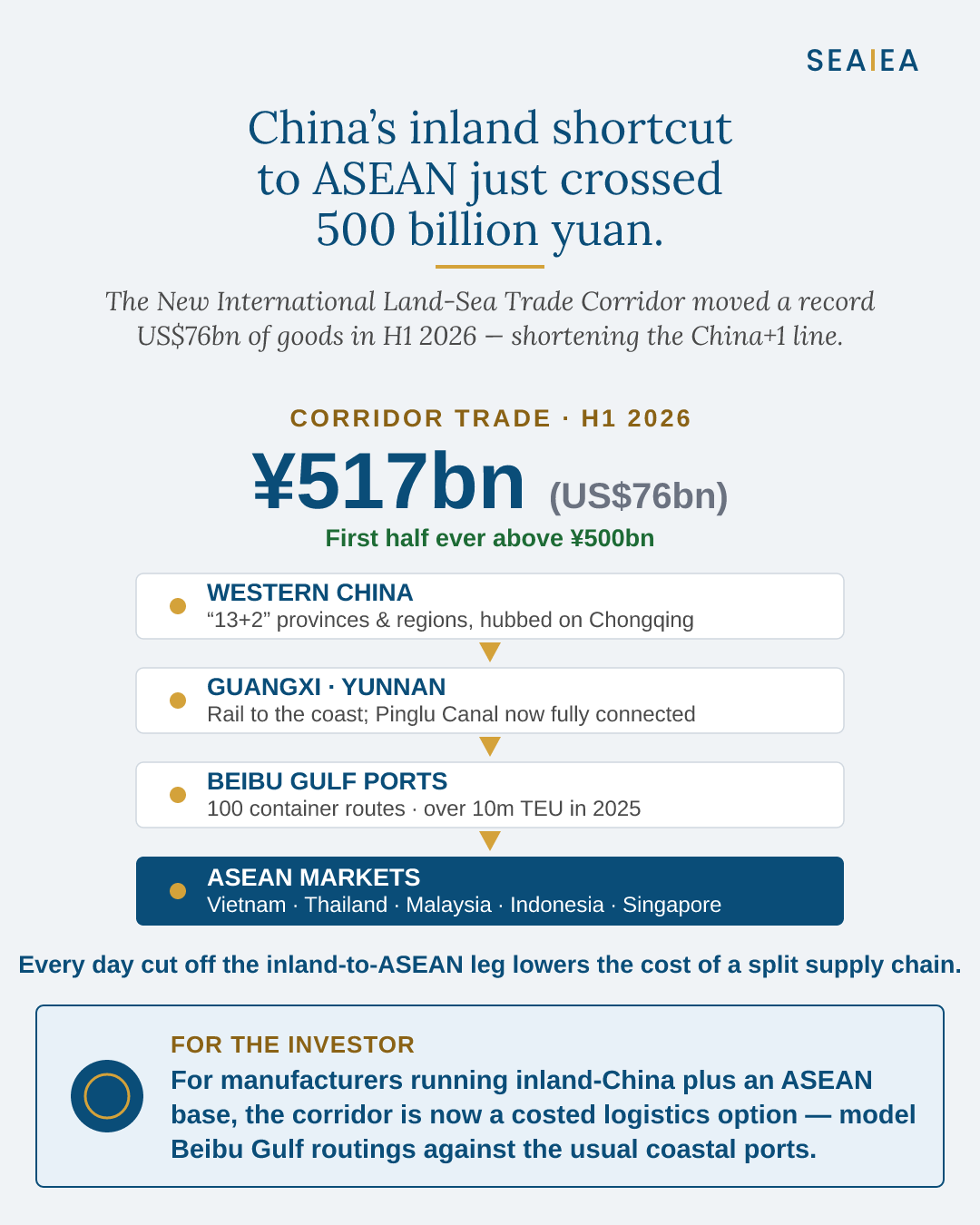
The read. Corridor trade reached ¥517bn (US$76bn) in the first half of 2026 — the first half-year ever above ¥500bn. The route matters more than the number: it runs from the “13+2” provinces of western China, hubbed on Chongqing, by rail through Guangxi and Yunnan — where the Pinglu Canal is now fully connected — to the Beibu Gulf ports, which carried over 10m TEU in 2025 across 100 container routes, and on into Vietnam, Thailand, Malaysia, Indonesia and Singapore. Every day cut off the inland-to-ASEAN leg lowers the cost of running a split supply chain.
What to watch. For manufacturers operating inland-China production alongside an ASEAN base, the corridor is no longer a policy ambition — it is a costed logistics option. The practical step is to model Beibu Gulf routings against the usual coastal-port assumptions and see where the landed-cost line now falls.
Get The Weekly Read every week
ASEAN investment commentary, free to subscribers.