Indonesia’s next downstreaming phase targets batteries and storage
Foreign investors supplied 70.9% of Indonesia’s downstream investment in the first half of 2026, making their response central to the next stage.
Jakarta’s three-stage progression runs from restricting raw ore exports to building processing capacity and pursuing higher-value production.
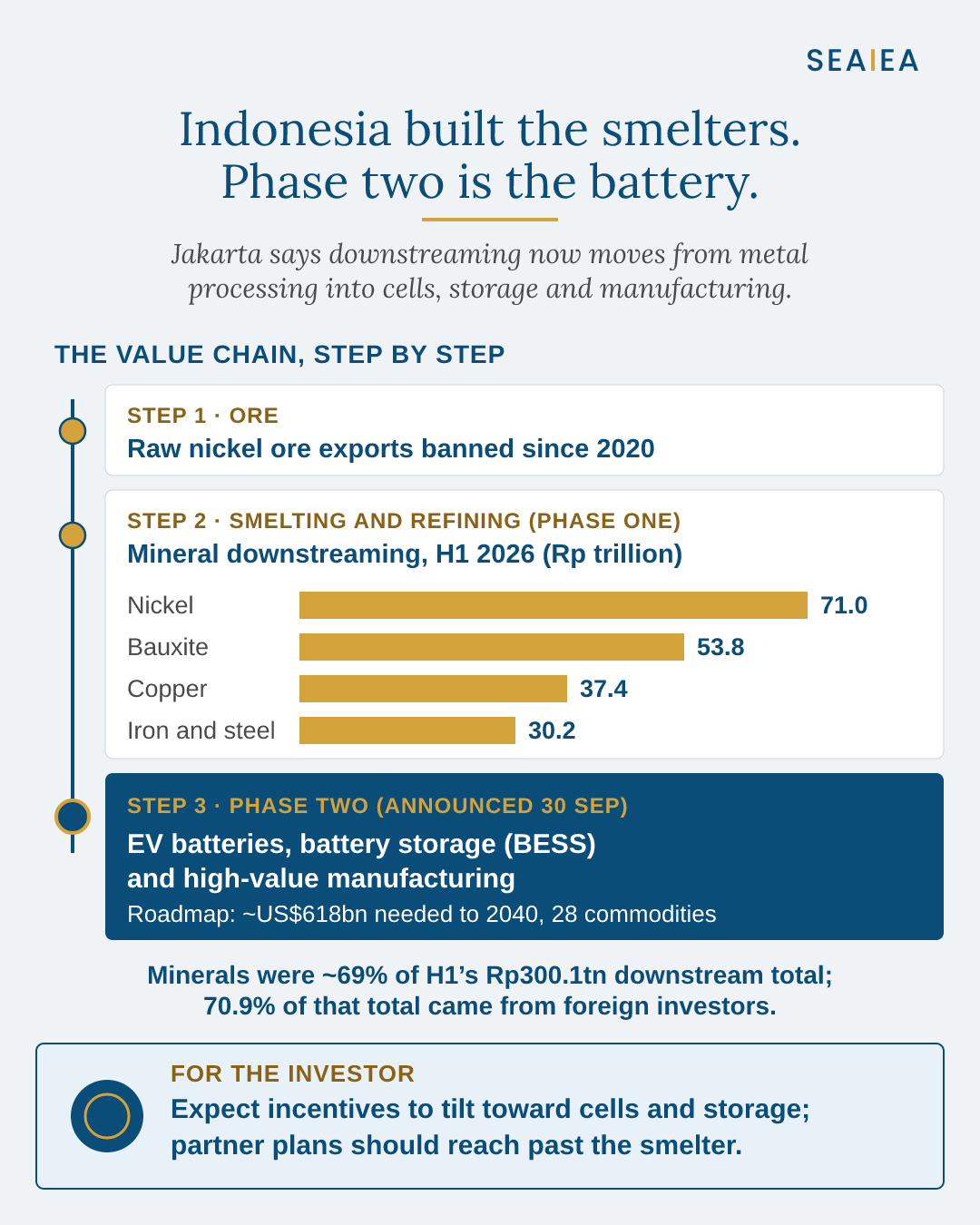
The read. Indonesia’s first phase of downstreaming began with its ban on raw nickel ore exports in 2020. The policy pushed investment into domestic smelting and refining, establishing the processing base that Jakarta now wants to extend further along the value chain.
That first phase continues to draw capital. In the first half of 2026, nickel attracted Rp71 trillion in downstream investment, followed by bauxite at Rp53.8 trillion, copper at Rp37.4 trillion, and iron and steel at Rp30.2 trillion. Minerals together accounted for about 69% of Indonesia’s Rp300.1 trillion in downstream investment during the period.
The newly announced second phase shifts the emphasis towards EV batteries, battery energy-storage systems and higher-value manufacturing. It sits within a 28-commodity low-carbon roadmap estimated to require about US$618 billion through 2040. Foreign investors supplied 70.9% of Indonesia’s total downstream investment in the first half, making their response central to the next stage.
What to watch. The practical test will be whether incentives and project approvals begin favouring battery cells, storage and manufacturing over additional stand-alone smelting capacity.
Investors and prospective partners will need plans that extend beyond processing raw material. Projects connecting refining to cells, storage or finished manufacturing should fit the new direction more closely; proposals that end at the smelter may face a more demanding case for approval and support.
Get The Weekly Read every week
ASEAN investment commentary, free to subscribers.