What 1,000 Rules and Incentives Reveal About Southeast Asia
Southeast Asia is changing the terms for foreign investors.
Over the last 2 months, I’ve tagged more than 1,000 rules and incentives across four Southeast Asian markets with one question: does this make life easier or harder for a foreign investor?
In SEAIEA Consulting’s databases, “loosening” means fewer restrictions or more support for investors. “Tightening” means more restrictions or less support. A measure can also contain changes in both directions (“mixed”) or make no change (“neutral”). Most records are neutral because they restate or reconfirm existing rules.
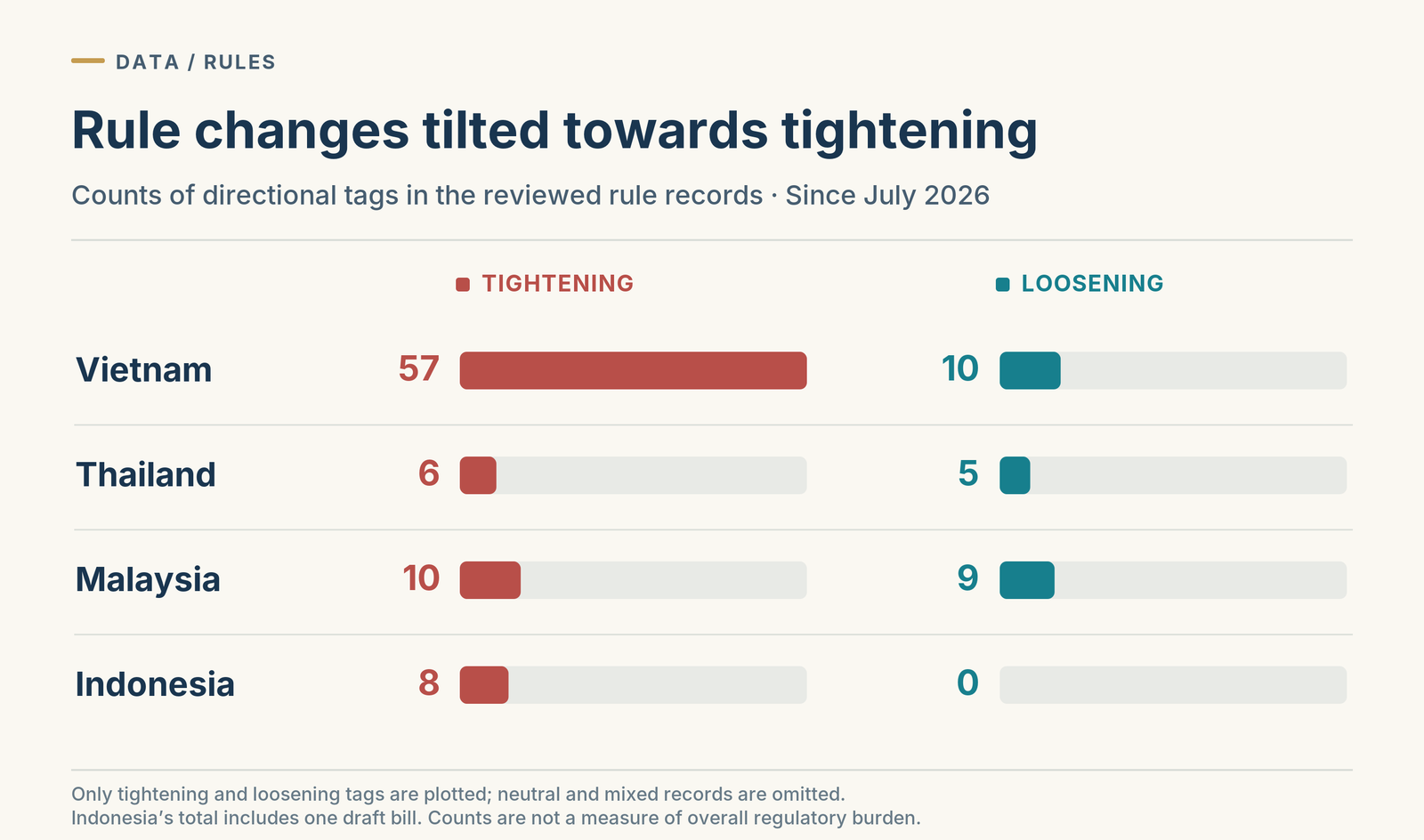
Vietnam is setting stricter requirements while offering more tax breaks and financial support.
Of the recent rule changes we reviewed, 57 tightened and 10 loosened, mainly affecting business permits and the environmental standards companies must meet. In August, five sets of cybersecurity rules were issued on the same day, covering licences for cybersecurity products and services and penalties for breaking personal data protection rules.
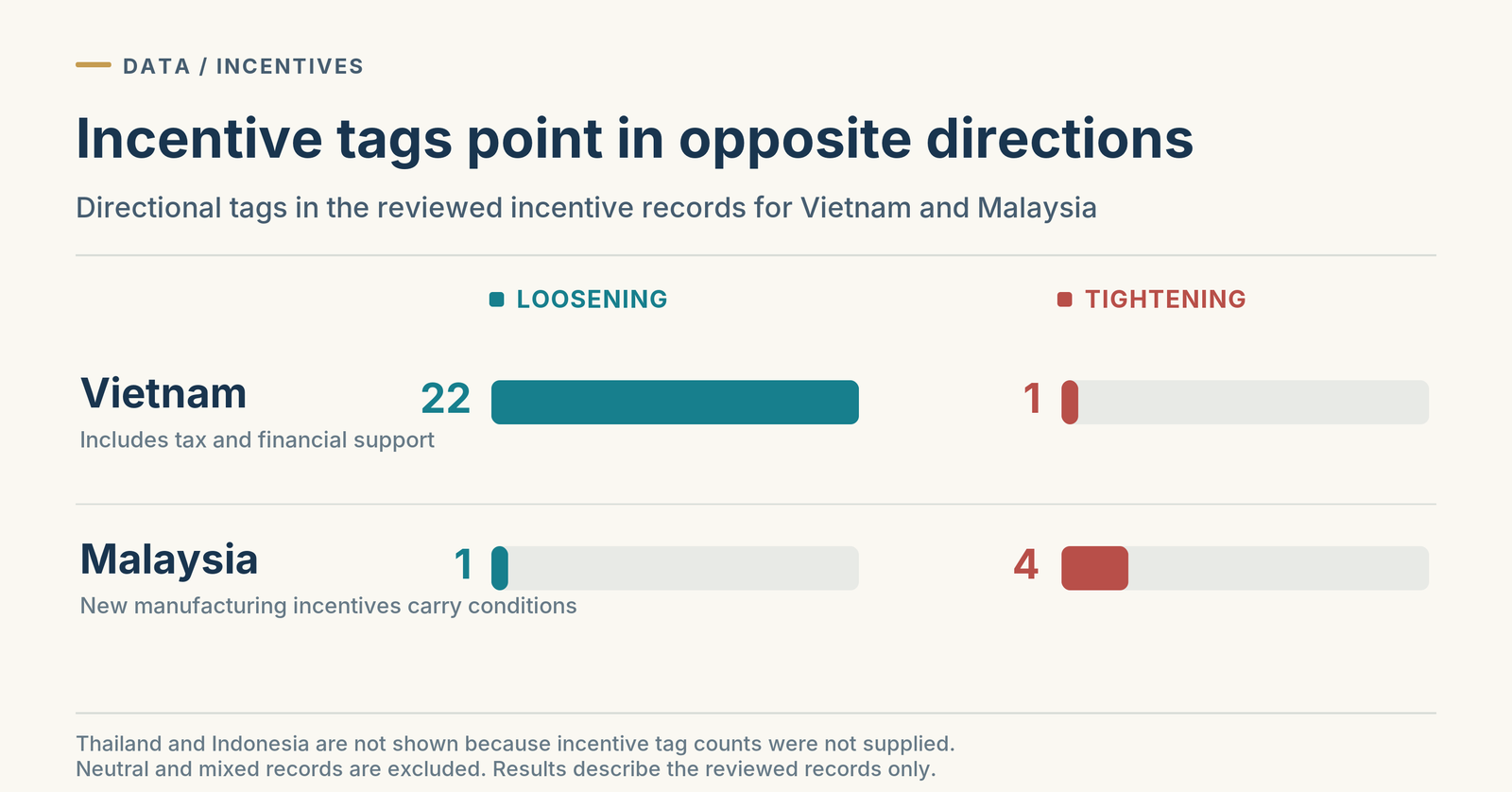
On incentives, 22 loosened and 1 tightened. They include a 10% tax rate on company profits for up to 30 years in Da Nang’s free-trade zone, a designated area with special tax and customs rules. Other support includes government funding for a first factory to manufacture semiconductor chips, help paying for research and development, and preference for domestic suppliers bidding for contracts.
Thailand’s rule tags split almost evenly: 6 tightening and 5 loosening.
In August, certain service businesses stopped needing a foreign-business permit—the special permission required for foreign-owned companies to provide those services. These include treasury centres, which manage cash and financing for a group of companies, and information technology and human resources services provided within the same group.
Thailand’s Board of Investment has added extra years without tax on company profits for groups that move manufacturing there with a centre coordinating their regional business operations. Companies approved for investment incentives can also receive extra years if they list their shares on the stock exchange.
The main tightening is a new set of technical requirements for power producers connected to the electricity network, taking effect in December.
Malaysia is putting conditions on its incentives.
Its rule tags were 10 tightening and 9 loosening; incentive tags were 4 tightening and 1 loosening. The largest change is the New Incentive Framework for manufacturing, open for applications since March.
Projects are assessed on local suppliers, workers’ skills, technology, and research and development. The score affects the tax rate, with specific commitments set for each company when its project is approved.
The one loosening was a new invitation for companies to bid to develop large-scale solar projects totalling 2,650 megawatts.
In Indonesia, 8 measures were tagged as tightening and none as loosening. One is still a draft bill.
Since June, coal and palm oil exports have gone through the state-owned company Danantara Sumberdaya Indonesia. An additional import tax now applies to six customs categories of yarn, and the required biodiesel content in diesel fuel rose to 50% in July. The government is taking more control over how commodities are exported and used at home.
These counts cover only the records we reviewed, and samples outside Vietnam are small. They show whether the reviewed measures ease or tighten conditions, not how much they affect a company’s costs or ability to operate.
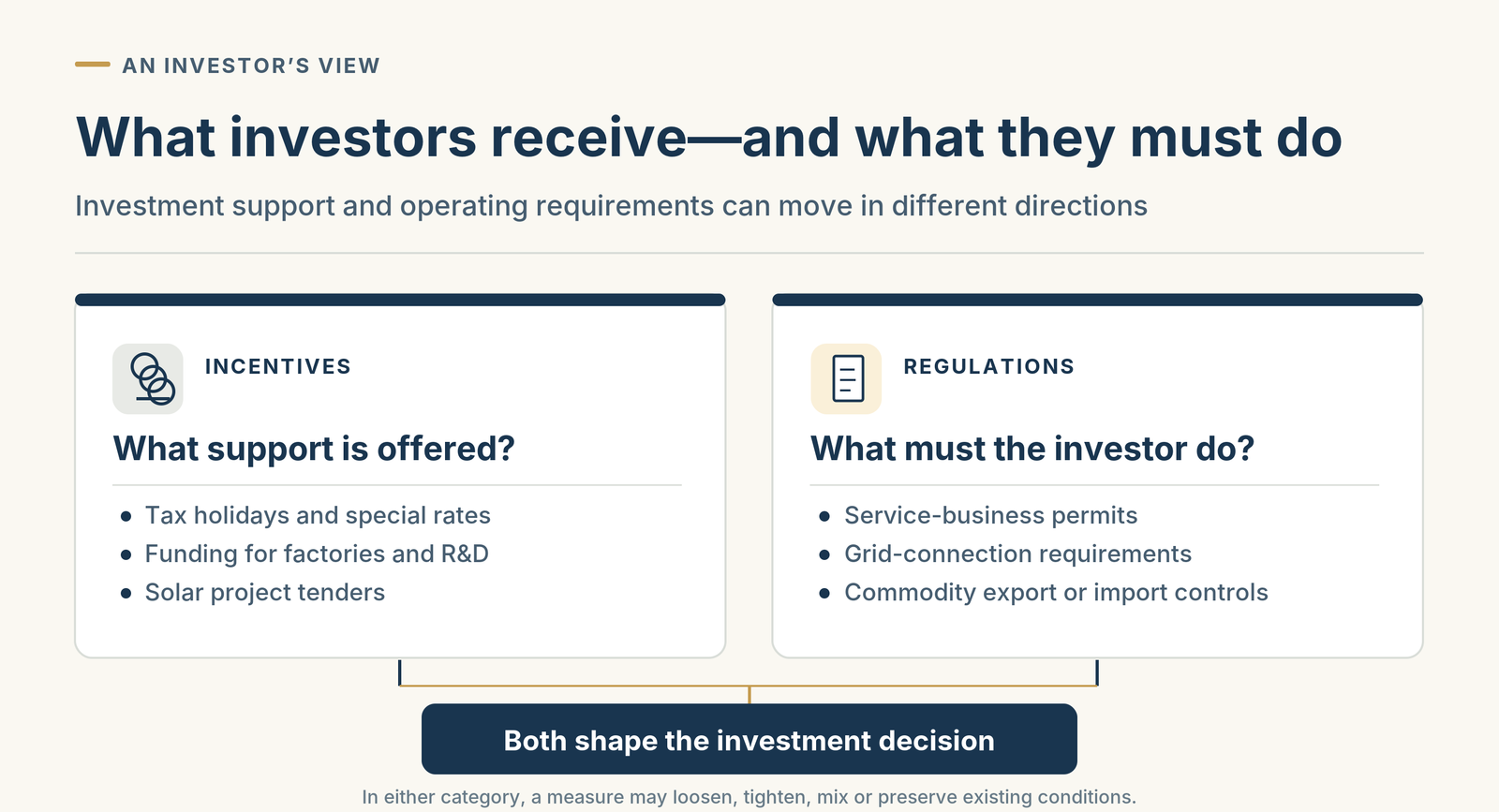
Most comparisons of investment locations start with tax breaks and funding. Changes in the rules tell you which permits a company will need and what requirements it will have to meet once it is there.
Get The Weekly Read every week
ASEAN investment commentary, free to subscribers.