Owning the Factory Isn’t Enough: The Approvals Behind Market Entry in Four ASEAN Economies
A foreign manufacturer can own its factory outright in Indonesia, Malaysia, Thailand and Vietnam, yet the approvals for trading spare parts and selling maintenance decide whether its business plan works.

A foreign manufacturer looking to establish a factory in Southeast Asia might assume that the main question is whether it can own the business outright. But foreign ownership is only part of the picture. A company may be allowed to own 100% of its factory while facing separate restrictions on selling imported spare parts or providing maintenance services.
These distinctions matter because manufacturers rarely earn revenue from production alone. Spare parts and after-sales services can be important parts of their business model. Depending on the country, these activities may require additional approvals, investment commitments or changes to how the business is organised.
To see how these differences work in practice, we follow the same hypothetical industrial pump manufacturer through Indonesia, Malaysia, Thailand and Vietnam.
This article is drawn from SEAIEA’s technical note, One Business, Four Rulebooks, which sets out the full country analysis, thresholds, reform timeline and sources. Request the technical note →
One business, four markets
Our investor wants a wholly foreign-owned subsidiary manufacturing industrial water pumps for sale to distributors. It would also import mechanical spare parts from unrelated overseas manufacturers and resell them through distributors, provide paid maintenance directly to industrial customers, and employ a small team of foreign specialists.
We assume the company operates at one site, makes no retail sales to end users, and excludes lubricants and other specially controlled goods. Maintenance means ordinary mechanical repair, not construction, statutory inspection or certification. The parent company comes from a World Trade Organization member but has no special bilateral treaty exemption. We start without investment-promotion approval, while considering whether promotion might help.
The comparison asks whether the company can own all the shares, conduct all three revenue-generating activities, meet the investment and staffing conditions, and begin operations on its intended timetable.
Looking beyond investment rankings
The OECD Foreign Direct Investment Restrictiveness Index offers a starting point. At year-end 2025, Vietnam scored 0.220, Thailand 0.240, Indonesia 0.282 and Malaysia 0.322. The index runs from zero to one, with lower scores indicating fewer formal restrictions. These figures predate the 2026 reforms.
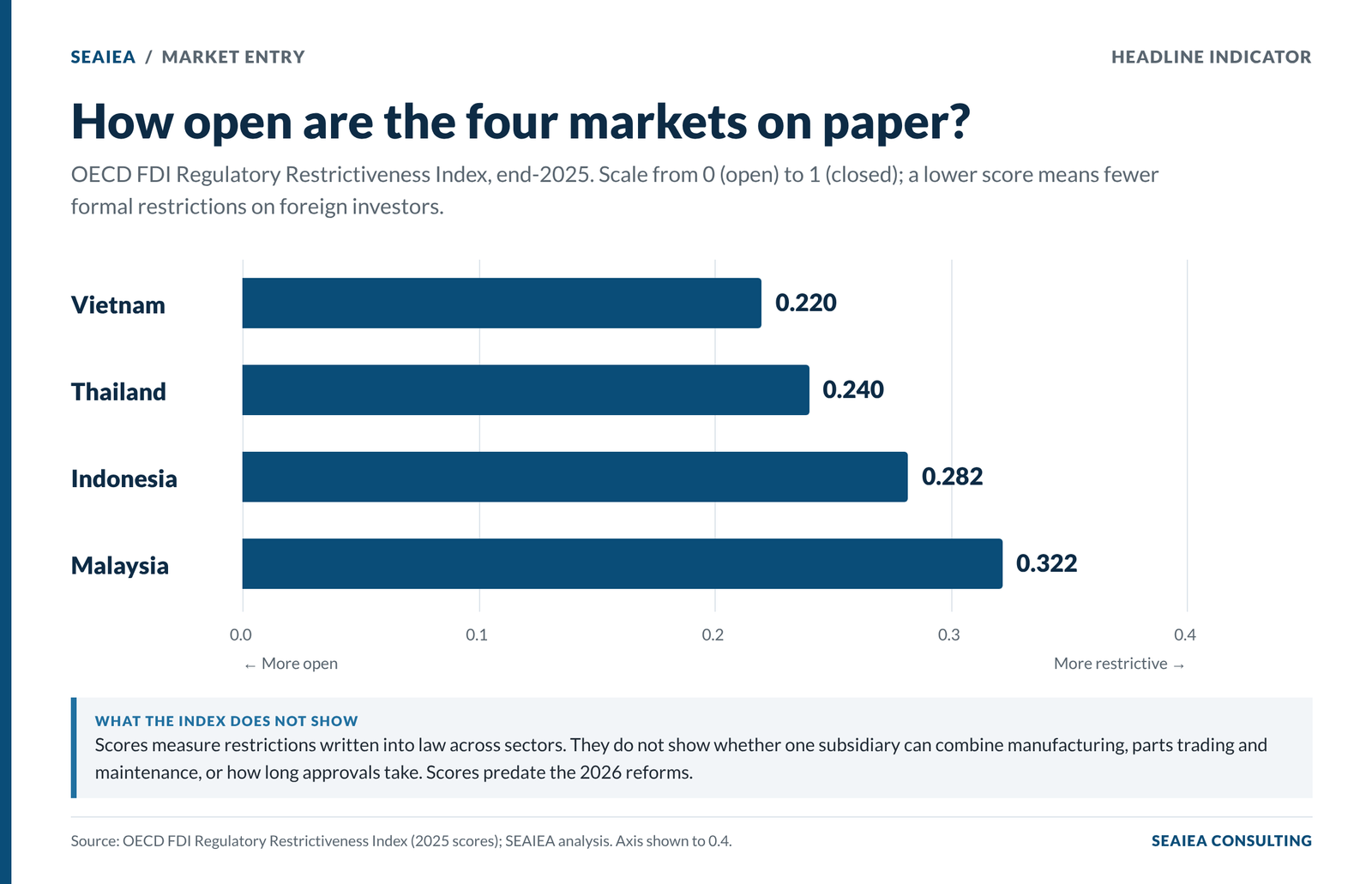
But broad scores cannot tell us whether a manufacturer can combine production, imported-parts trading and maintenance in one subsidiary, or what approvals it needs. Nor do they measure how officials administer the rules.
Using SEAIEA’s regulatory database, we identified relevant requirements and checked legal texts and official guidance against this business model. The analysis covers rules in force as of 1 November 2026, distinguishing later changes. We concentrate on foreign-investor restrictions and conditions for investment promotion, rather than ordinary factory and environmental approvals that generally apply to local and foreign firms alike.
Indonesia: One factory, several investment requirements
In Indonesia, the manufacturer needs to decide which activities its subsidiary will perform. Even at one factory, manufacturing, spare-parts trading and maintenance are not necessarily treated as a single operation.
Indonesia assigns business classification codes, or KBLI codes, to different activities. Pump manufacturing falls under 28130 and repair under 33121. Reselling imported parts made by other companies needs a separate trading classification. A manufacturer can sell products it makes itself without a separate trade-business licence, but third-party goods are different.
This distinction affects investment. Foreign-invested companies must have at least IDR2.5 billion in paid-up capital. Separately, planned project investment must generally exceed IDR10 billion per five-digit business activity per location, excluding land and buildings. Certain related wholesale activities, and qualifying manufacturing activities within one production line, can be grouped. Other revenue-generating activities may need to meet the requirement separately.
Suppose our company allocates IDR20 billion to manufacturing, IDR12 billion to wholesale and IDR3 billion to maintenance. The IDR35 billion total looks sufficient, but not every activity necessarily qualifies. If maintenance is assessed separately, its IDR3 billion allocation may be too small. Imported parts classified under wholesale codes that cannot be grouped could create another problem.
The company must check whether maintenance can be assessed with manufacturing. If not, it may have to invest more or change its service model. An independent provider could contract directly with customers, but the manufacturer would then lose maintenance revenue and the direct customer relationship. Merely subcontracting repairs while keeping the customer contracts would not necessarily resolve its own licensing position.
Pump manufacturing also carries a local commercial partnership requirement under Presidential Regulation 49/2021. This does not automatically require an Indonesian shareholder, so full foreign ownership remains possible if the partnership conditions are met.
The company would then register through the Online Single Submission system. Its business identification number does not necessarily authorise every activity; further approvals depend on the relevant risk classifications. Employing foreign specialists normally requires an approved foreign-worker employment plan, unless an exemption applies.
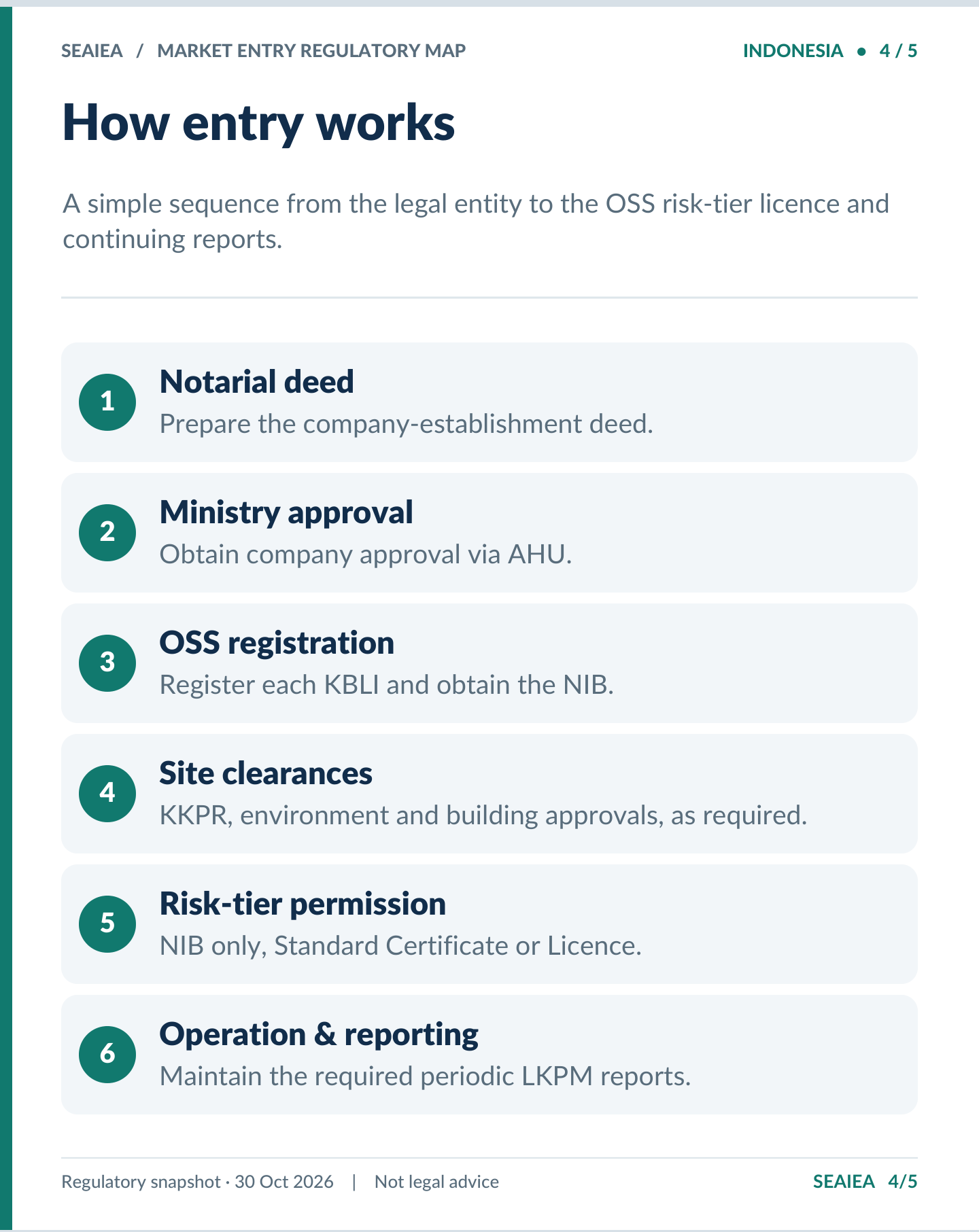
Indonesia’s central question is whether the company’s proposed activities fit within its investment plan, rather than simply whether it can own the factory.
Malaysia: Manufacturing is straightforward, but what about trading?
Malaysia allows full foreign ownership of new manufacturing projects. A manufacturing licence is required when shareholders’ funds reach RM2.5 million or the company employs 75 full-time paid workers. These are licensing thresholds, not fees paid to obtain a licence.
The difficult question concerns the imported spare parts. Malaysia’s 2022 distributive-trade guidelines exempt licensed manufacturers distributing products from their own production line. Selling the pumps it makes may therefore fall within the exemption. But what about parts imported from unrelated manufacturers? The guidelines do not clearly settle whether this mixed catalogue remains exempt.
The company would need to clarify its product range and sales model with the authorities. If the sales instead fall under the category of “various other distribution formats,” the guidelines specify RM1 million in shareholders’ funds. This is a separate condition, not necessarily another RM1 million on top of the manufacturing-licence threshold. The company might already meet both.
Maintenance is less uncertain. The Malaysian Investment Development Authority’s published guidance specifies no foreign-equity restriction for ordinary machinery maintenance, supporting the possibility of keeping the service fully foreign-owned.
Foreign specialists bring separate costs. Since June 2026, minimum monthly basic salaries for Employment Pass categories I, II and III have been RM20,000, RM10,000 and generally RM5,000 respectively. From January 2027, applications for categories II and III will also require plans to develop local employees who can take over those roles.
Malaysia’s New Incentive Framework, introduced in March 2026, links support to outcomes such as developing local suppliers and higher-value jobs. The company would need to weigh the benefits against those commitments.
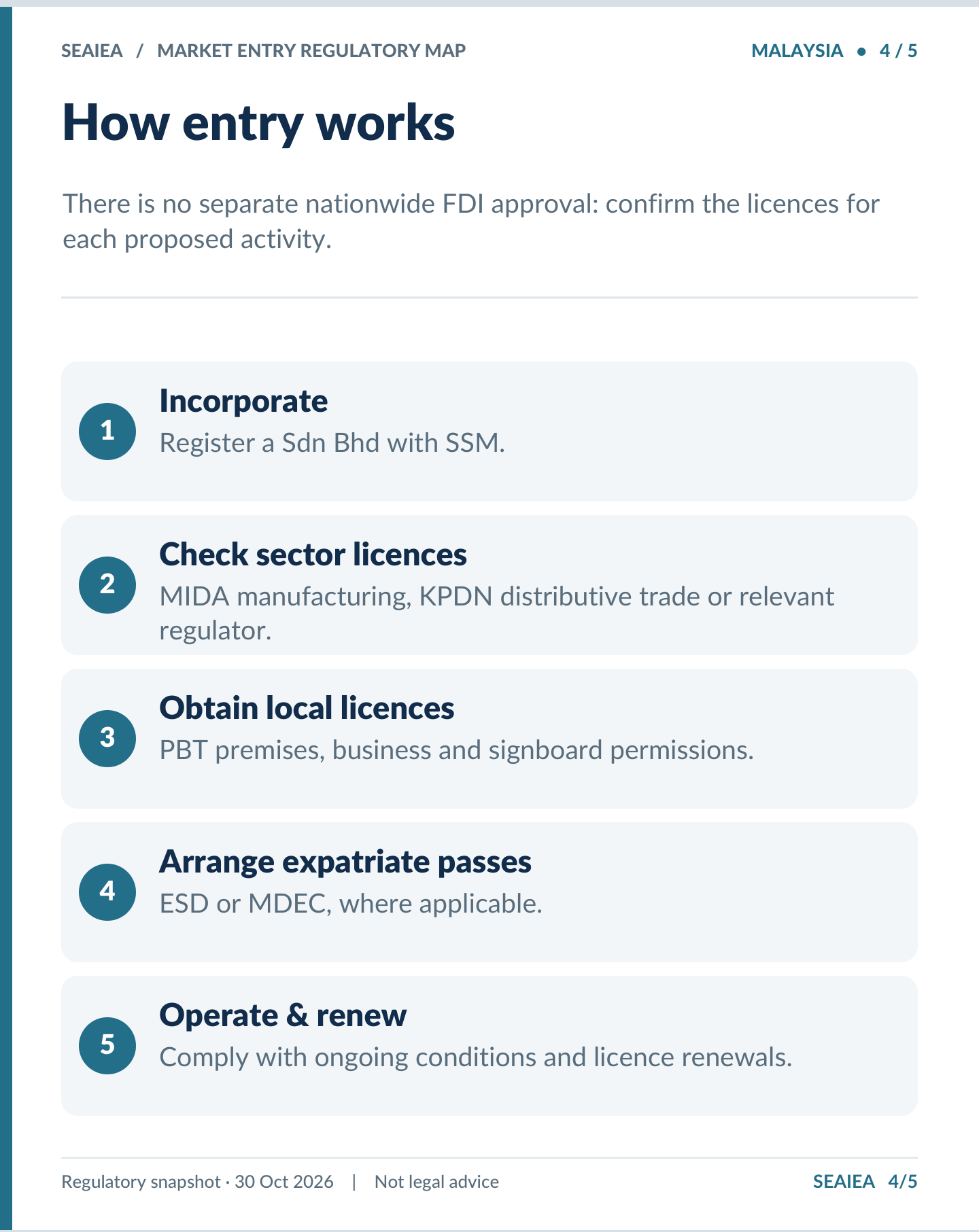
Unlike Indonesia, where the question is whether maintenance meets a separate investment test, Malaysia’s main uncertainty is whether the manufacturer’s exemption extends to products it does not make.
Thailand: Choosing the right route for trading and maintenance
Thailand generally permits full foreign ownership of ordinary manufacturing. But imported-parts wholesale and paid maintenance must each be examined under the Foreign Business Act (FBA).
For wholesale, the company could seek a Foreign Business Licence or meet the capital threshold that places the activity outside the relevant restriction. Wholesale establishments with less than THB100 million in capital fall within the restricted category. The THB100 million is capital in the business, not a licence fee. Meeting it would not automatically authorise paid maintenance.
Maintenance requires its own assessment. In considering licence applications, the Department of Business Development looks at whether the applicant services goods made or sold by itself or its group, the expertise involved and how the service operation will work. These factors may support an application but do not guarantee approval.
Investment promotion offers another possibility. For a qualifying activity approved by the Board of Investment (BOI), the company may obtain a Foreign Business Certificate instead of a Foreign Business Licence. One potential route is the Trade and Investment Support Office (TISO) category, covering specified machinery-related trading and support activities. The company would need to establish whether its imported parts and maintenance services qualify.
The routes create different financial commitments. TISO requires at least THB10 million a year in selling and administrative expenses, while the wholesale exclusion depends on THB100 million in capital. These are not equivalent costs. A company already incurring qualifying annual expenses might prefer TISO; another may find a licence or the wholesale capital route more practical.
The FBA also has general minimum-capital rules, ordinarily THB2 million for a foreign business or at least THB3 million for each restricted business requiring permission. These are distinct from the wholesale threshold.
Service exemptions introduced in August 2026 cover certain activities, including some services between related companies, but do not automatically exempt mechanical maintenance for outside customers. Ordinary foreign-worker criteria also involve capital and Thai-employee requirements, with different arrangements possible for BOI-promoted projects.
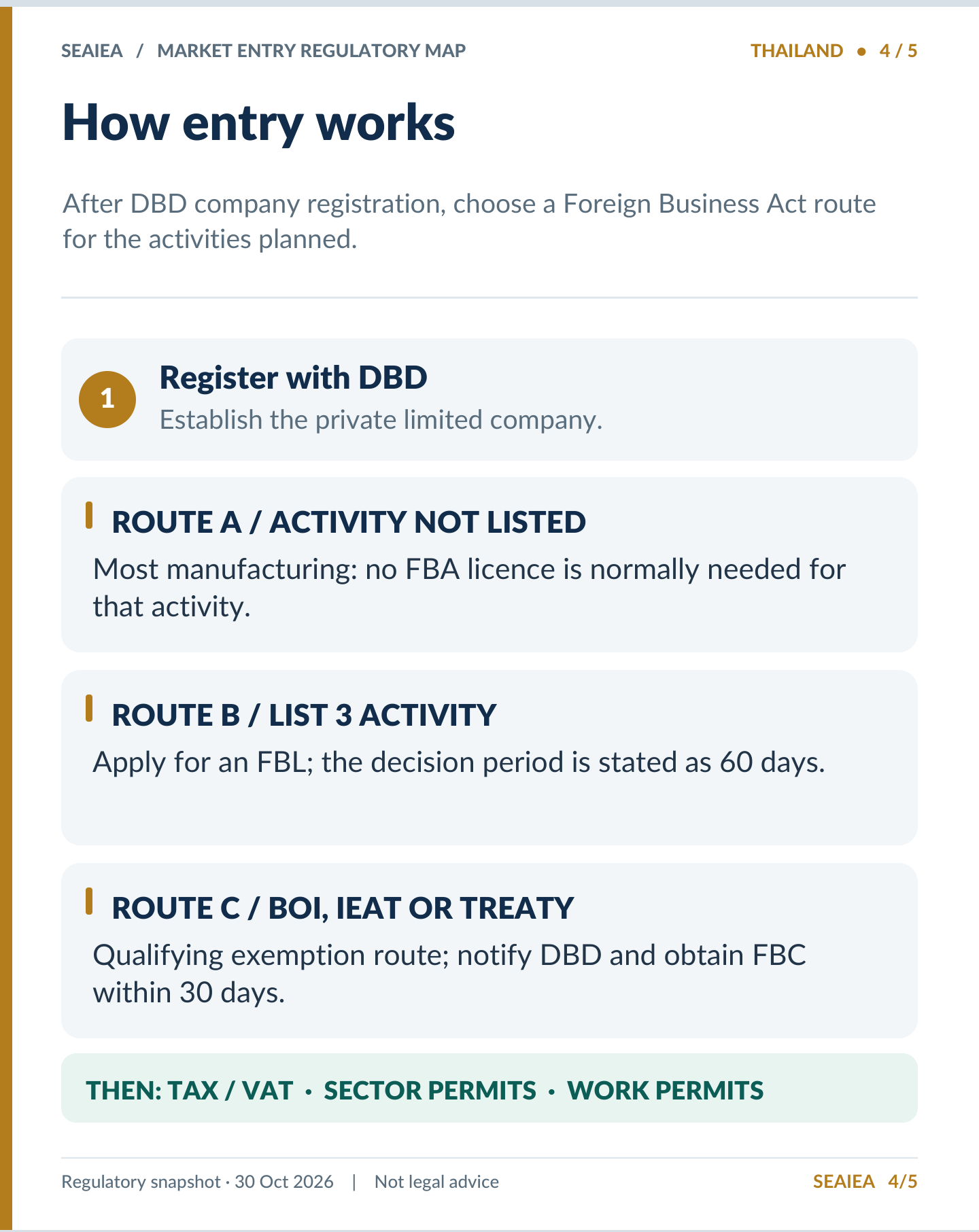
Thailand’s challenge is choosing a route that covers each revenue stream. Permission for trading does not necessarily cover maintenance, and the most practical route depends on the company’s existing capital and expenses.
Vietnam: Getting the registration sequence right
Vietnam offers a relatively clear route to full foreign ownership of manufacturing, ordinary equipment maintenance and distribution. Earlier foreign-equity transition periods under its WTO commitments have expired.
Under Decree 342/2026, effective 18 October 2026, the company can generally sell the specified imported mechanical parts to distributors without a separate trading business licence after completing the required registrations. This continues the treatment under the previous decree. The distinction matters: sales to distributors for resale are wholesale, while sales to businesses using the parts themselves could fall under retail rules.
The more important issue is registration. Vietnam uses an Enterprise Registration Certificate to establish the company and an Investment Registration Certificate for the project. Decree 96/2026 allows the company to register first and obtain its investment certificate within 12 months. But it cannot implement the project or add other registered activities before obtaining that certificate.
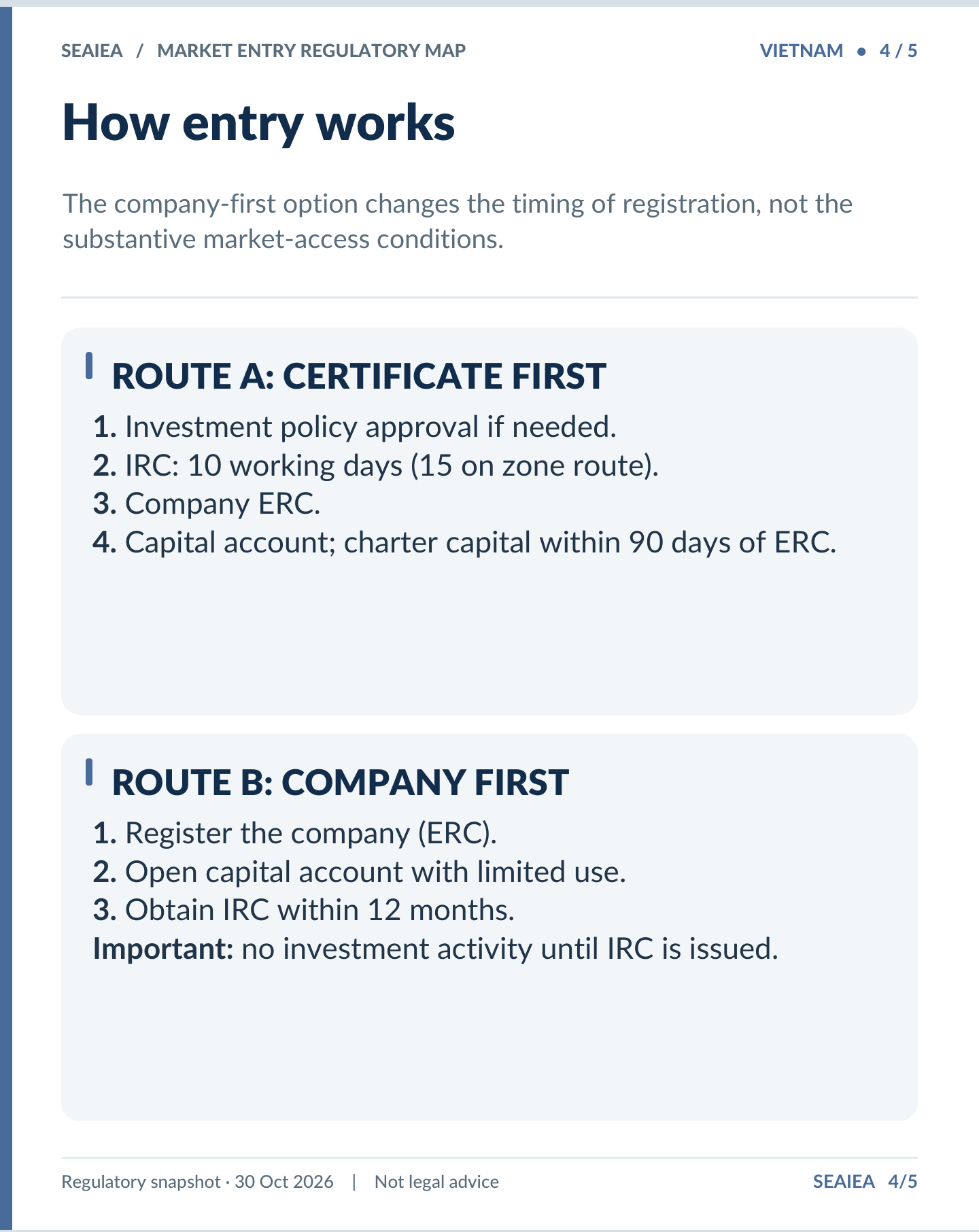
That flexibility has a cost. Registering early starts corporate obligations before the project can proceed. Shareholders generally must contribute charter capital within 90 days of enterprise registration, subject to exceptions for certain asset contributions. The 12-month project-registration window does not extend this deadline. The company may therefore need to contribute capital before it can start production.
A government clarification in October 2026 showed how this can become difficult. A consultant reported that banks had asked for an investment certificate before opening a company’s capital account, even as its capital deadline approached. The Ministry of Finance clarified that accounts could be opened before the certificate, with limited uses including receiving capital and paying lawful project-preparation expenses.
Foreign specialists also require work-permit assessments. The ordinary expert route generally requires a university qualification or equivalent and two years’ relevant experience. A further route based on five years’ experience is scheduled from December 2026.
Vietnam’s main challenge is thus sequencing: the activities are generally open to the manufacturer, but registration and funding deadlines can begin before operations are ready.
Which market makes the most sense?
For this specific business model, Vietnam and Malaysia appear to offer the clearest regulatory routes.
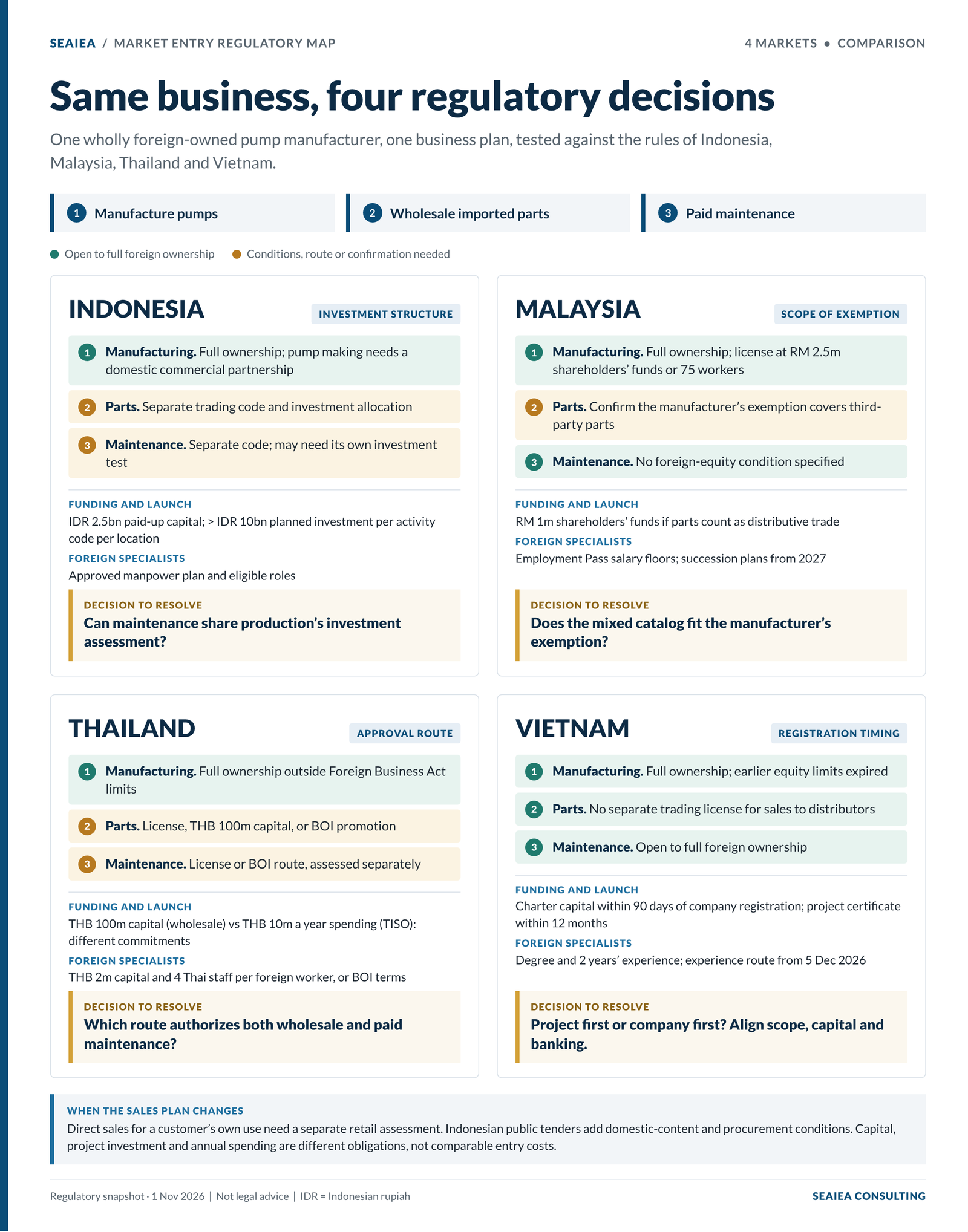
Vietnam permits the three activities under full foreign ownership, with the main risks concerning registration and timing. Malaysia is a close alternative, provided its treatment of third-party parts can be settled on acceptable terms. If so, market demand, production costs, logistics and suppliers could matter more than the regulatory difference.
This finding does not follow the OECD scores. Malaysia has the highest restrictiveness score of the four, yet many of those restrictions do not affect this manufacturer.
Thailand and Indonesia are harder to separate. Thailand offers different approval or exemption routes for trading and maintenance, but a route covering one may not cover the other. Indonesia’s problem is whether planned investment meets the requirements for each activity. A company with sufficient investment allocated in Indonesia may prefer that route; one eligible for BOI promotion may find Thailand more practical.
These are judgments about this company’s proposed revenue model, not about the overall attractiveness of the four markets.
Beyond ownership
Our manufacturer could own its factory outright in all four countries, yet the rules for trading and maintenance would still shape its business. They could require more investment, delay revenue or force it to hand customer relationships to independent providers.
For investors, the question is not simply whether they can own a factory. It is whether they can operate the business they actually intend to build.
Read the full analysis. One Business, Four Rulebooks: A Regulatory Comparison of Market Entry in Indonesia, Malaysia, Thailand and Vietnam sets out every requirement behind this article: the country-by-country legal pathways, investment and capital thresholds, a 2025–2027 reform timeline, questions to resolve before registration, regulatory maps for each market and full sources. Request the technical note, or tell us about a different business model and we will advise how we would approach it.
This article describes the regulatory position as of 1 November 2026 for a hypothetical company. It is not legal advice. Investors should confirm the applicable rules with the authorities and their advisers.
Get The Weekly Read every week
ASEAN investment commentary, free to subscribers.