Thailand’s $80bn Chip Target Already Has $27.2bn in Applications
Applications lodged since 2023 already equal 34% of the country’s 2050 investment target.
Thailand begins its semiconductor push with a substantial investment pipeline, but applications are still an earlier stage than funded projects or operating capacity.
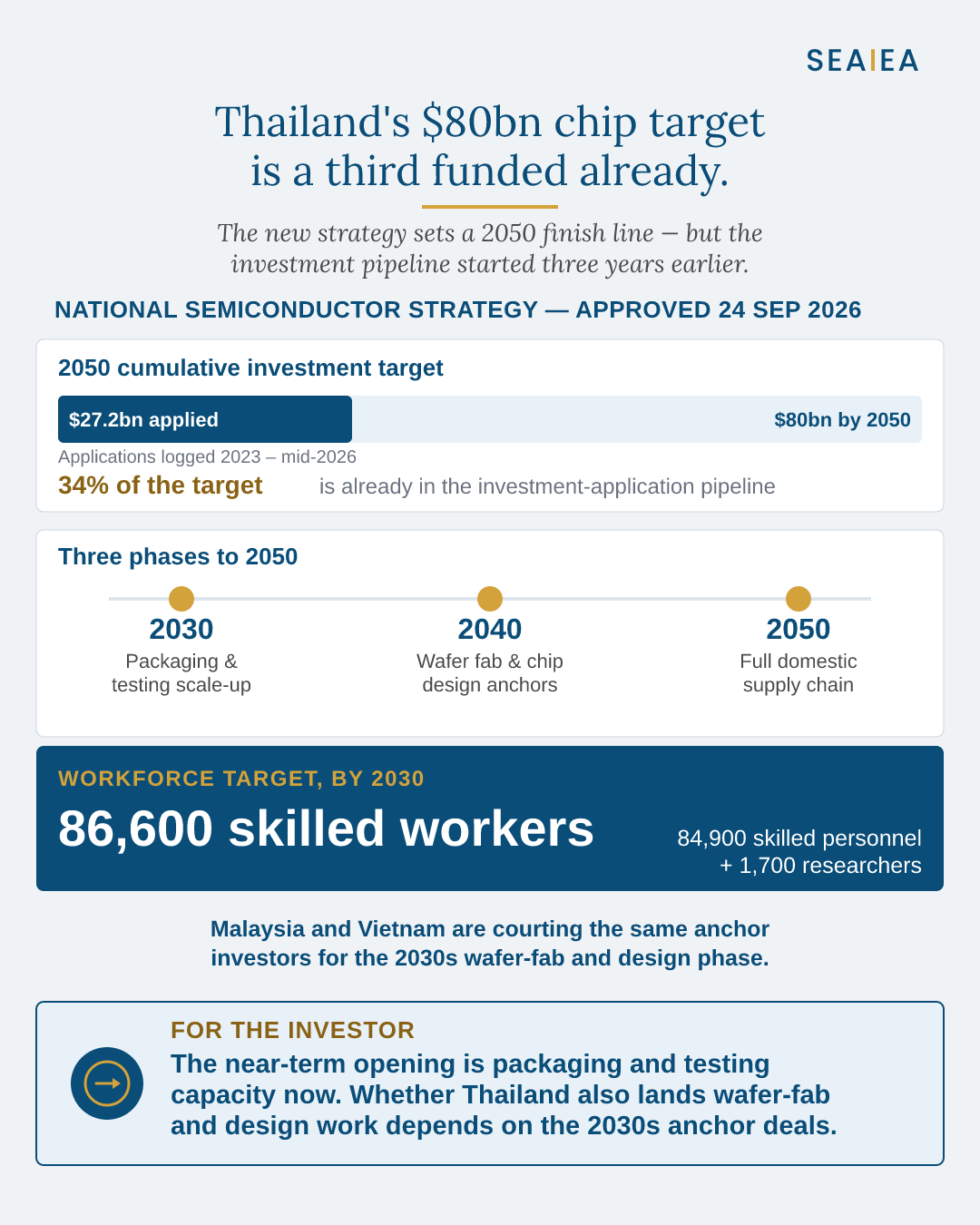
The read. Thailand approved its first National Semiconductor Strategy on 24 September, setting a cumulative investment target of US$80 billion and more than 230,000 new jobs by 2050. The plan begins with a substantial pipeline: semiconductor-related investment applications lodged since 2023 total 909 billion baht, or about US$27.2 billion. That is 34% of the long-term target, although applications are still an earlier stage than funded projects or operating capacity.
The strategy divides the build-out into three phases. Advanced packaging and testing are expected to scale by 2030. The next phase seeks anchor investors in wafer fabrication and chip design by 2040, followed by a complete domestic semiconductor supply chain by 2050.
Workforce development is front-loaded. Thailand aims to train 86,600 skilled workers by 2030: 84,900 skilled personnel and 1,700 researchers across areas including photonics, power semiconductors and sensors. That labour pool will be part of the test of whether the application pipeline can become operating capacity.
What to watch. Packaging, testing and power semiconductors provide the clearest near-term opening. Progress into wafer fabrication and design will depend on whether Thailand secures the anchor projects envisaged for the 2030s.
Malaysia and Vietnam are courting many of the same investors. Thailand’s application total shows early momentum; the eventual location of those anchor investments will determine how far it moves beyond back-end manufacturing.
Get The Weekly Read every week
ASEAN investment commentary, free to subscribers.