Vietnam opens 29 expressway projects to private capital
Vietnam has secured only one-third of the VND1,269 trillion required for its 2026–2030 expressway programme, leaving about US$32 billion to mobilise.
The largest tenders show where scale, financing capacity and project readiness will be tested first.
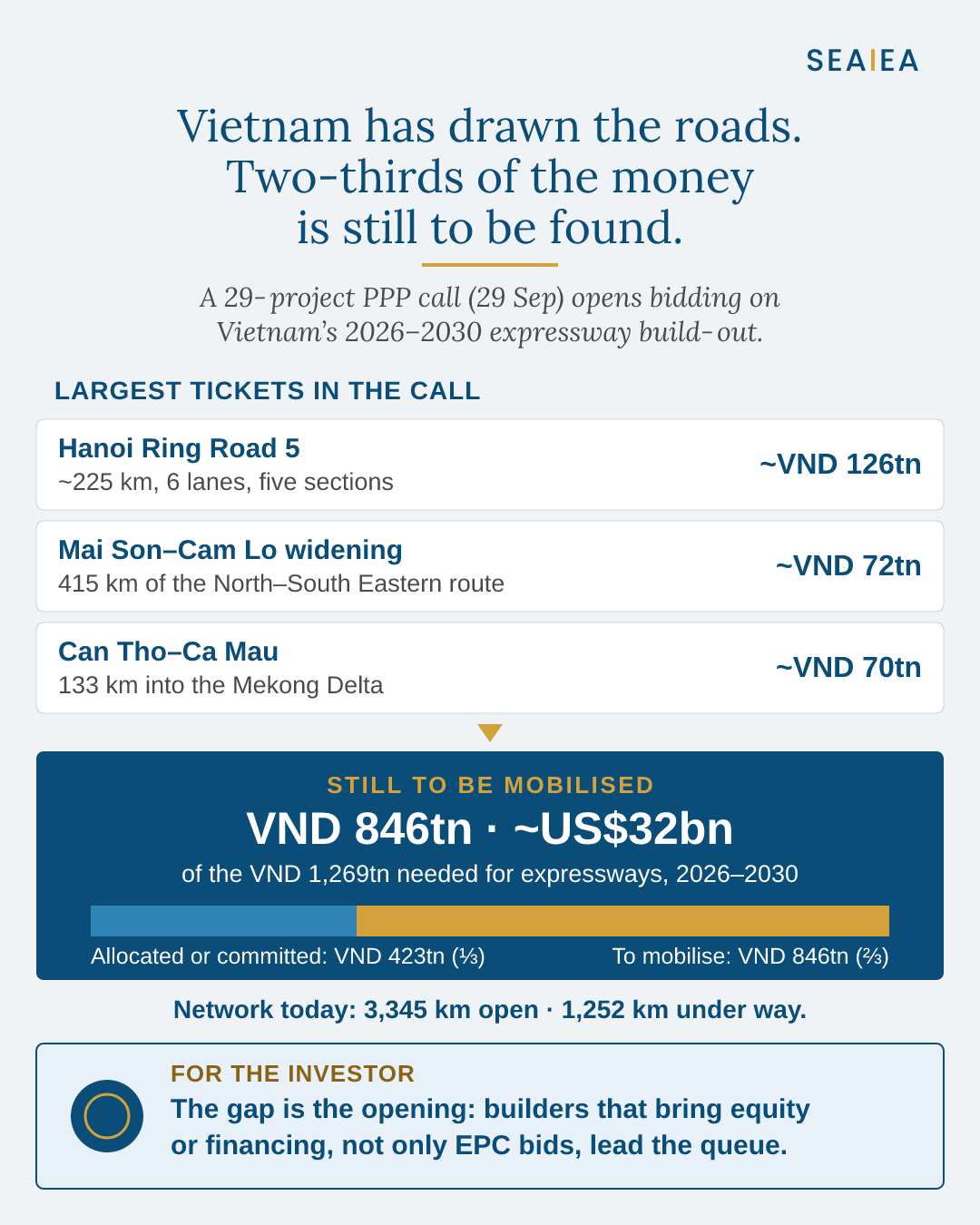
The read. Vietnam’s expressway programme is moving from mapped ambition to a defined procurement pipeline. The 29-project call covers around 2,829 kilometres of new expressway and 1,187 kilometres of upgrades. It adds to a network that already has 3,345 kilometres open and another 1,252 kilometres under way.
The funding requirement is substantial. Vietnam’s 2026–2030 expressway plans need VND1,269 trillion, but only VND423 trillion has been allocated or committed. That leaves VND846 trillion—about US$32 billion, or two-thirds of the total—to be mobilised.
The largest projects illustrate the scale. Hanoi Ring Road 5 is planned as roughly 225 kilometres of six-lane road across five sections, costing around VND126 trillion. Widening 415 kilometres of the Mai Son–Cam Lo section of the North–South Eastern route is priced at about VND72 trillion. The 133-kilometre Can Tho–Ca Mau link into the Mekong Delta is another VND70 trillion.
What to watch. Financing capacity is likely to matter alongside construction credentials. Builders able to contribute equity or arrange funding will be better placed than contractors offering only an EPC bid.
The next signal will be how the 29 projects are sequenced and which structures attract credible private financing first. Early awards should also indicate where the government sees the strongest combination of transport demand, investor appetite and readiness to proceed.
Get The Weekly Read every week
ASEAN investment commentary, free to subscribers.