Malaysia’s China Visit Brought an RM28bn Pledge and a Signed Transport Pact
Malaysia’s RM28 billion investment pledge remains a pipeline, while a new transport framework offers a more immediate commercial channel.
The investment may take years to materialise. The transport framework is already in force.
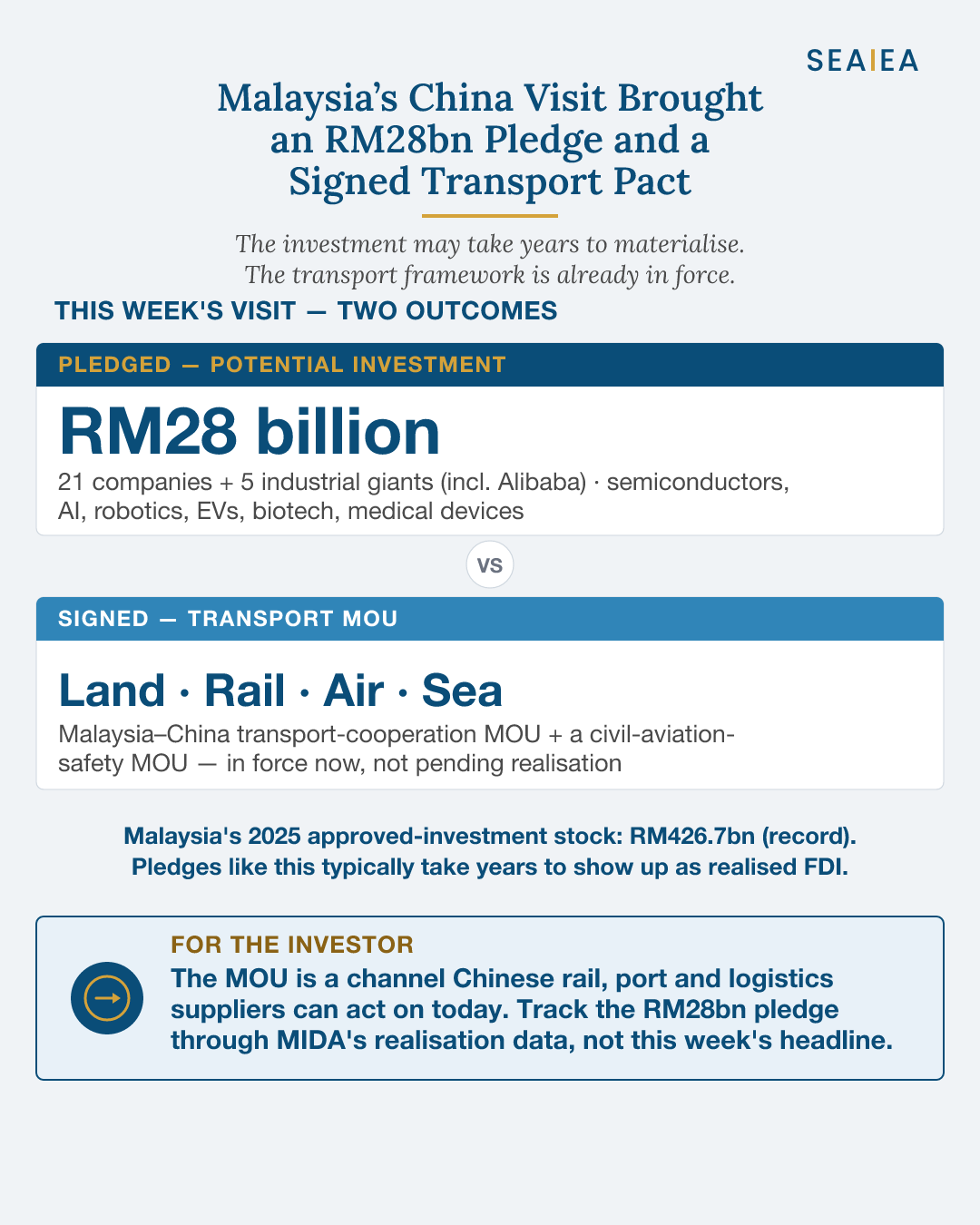
The read. Prime Minister Anwar Ibrahim’s three-day visit to Shanghai and Hangzhou concluded on 24 September with more than RM28 billion in potential investment commitments. The figure followed a roundtable with 21 Chinese companies and separate meetings with five industrial groups, including Alibaba, across semiconductors, AI, robotics, electric vehicles, biotechnology and advanced medical devices.
The distinction is timing. The RM28 billion is an announcement-stage pipeline whose eventual value will depend on projects moving from interest to approval and implementation. Malaysia recorded RM426.7 billion in approved investment in 2025, a record, but pledges such as these typically take years to appear as realised foreign investment.
The transport agreements are further along. Malaysia and China signed a formal cooperation framework covering land, rail, maritime and air transport and logistics, including technical exchange, AI adoption and low-carbon infrastructure. Their aviation regulators also signed a civil-aviation-safety agreement covering certification and flight-operations oversight.
What to watch. Track MIDA’s realisation data for evidence that the pledged projects are becoming committed expenditure. The sectors, locations and implementation schedules will matter alongside the eventual total.
The transport framework offers the more immediate commercial channel. Chinese rail, port and logistics-technology suppliers can begin positioning for Malaysia’s infrastructure pipeline while the investment pledges develop.
Get The Weekly Read every week
ASEAN investment commentary, free to subscribers.