Pinglu Canal opens a shorter freight route from south-west China to Southeast Asia
The Pinglu Canal gives south-west China a shorter river route to the Beibu Gulf, changing the logistics calculation for trade with Southeast Asia.
The new Pinglu Canal links south-west China’s river network directly to the Beibu Gulf.
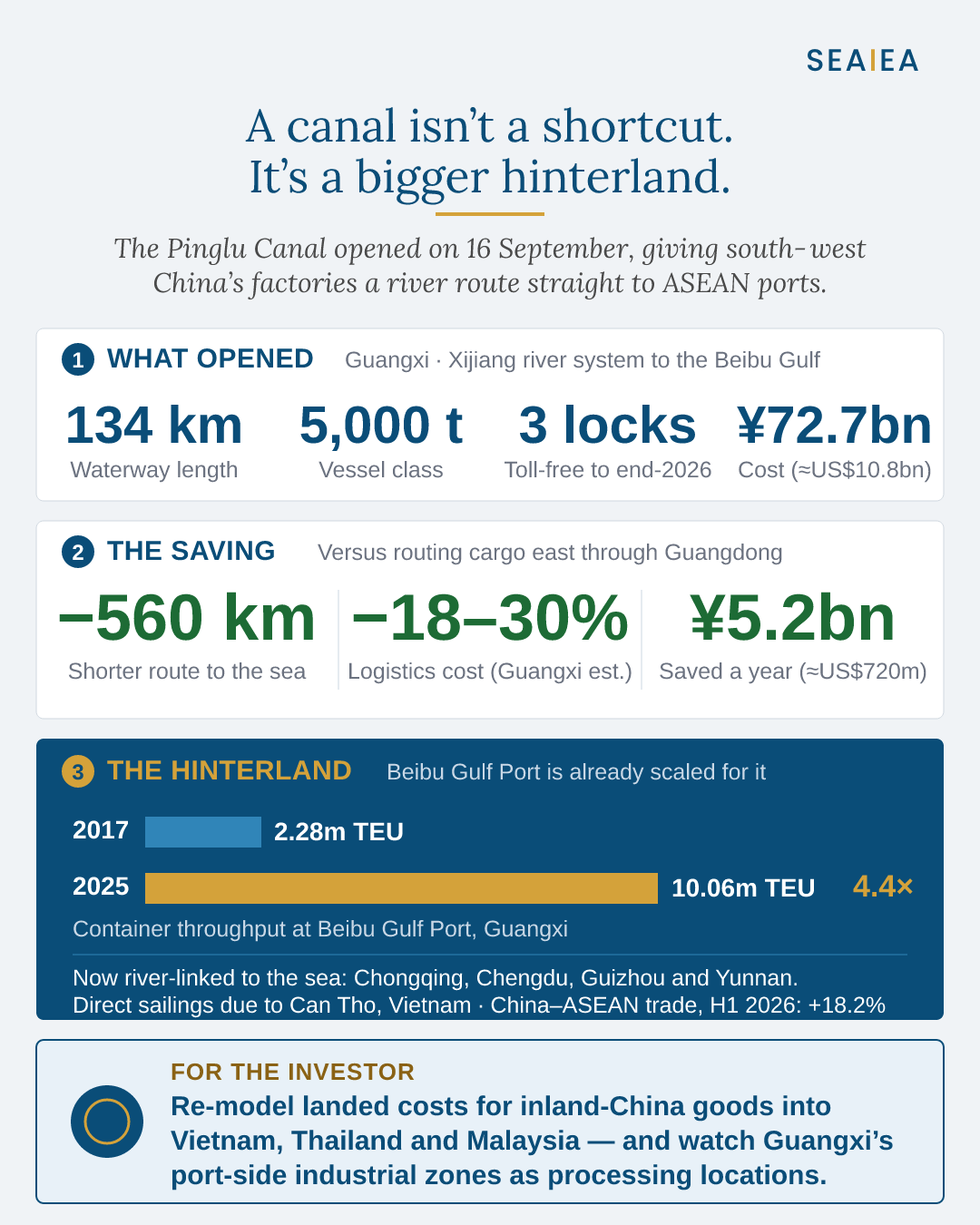
The read. The 134 km Pinglu Canal opened on 16 September, connecting Guangxi’s Xijiang river system directly to the Beibu Gulf. It gives 5,000-tonne vessels a route to the sea that is 560 km shorter than sending cargo east through Guangdong. Guangxi estimates that could cut logistics costs by 18–30%, with tolls waived until the end of 2026.
The bigger change is where that route begins. Chongqing, Chengdu, Guizhou and Yunnan now have a river connection to the Beibu Gulf, whose container throughput has already grown from 2.28 million TEU in 2017 to 10.06 million in 2025. New direct sailings to Can Tho in Vietnam are also planned.
For manufacturers, that changes the logistics calculation between inland China and Southeast Asia. Factories that previously depended heavily on long overland journeys to China’s eastern ports now have another route south. That could make south-west China more closely connected to production and customers across ASEAN.
What to watch. The first question is whether the projected savings show up in actual freight rates once the canal settles into regular operation. The toll-free period makes the initial economics particularly attractive, so what happens after the end of 2026 will matter.
Further out, watch the industrial zones around Guangxi’s ports. If manufacturers and processors begin locating there to take advantage of the new route, the canal will be doing more than moving existing cargo more cheaply. It will be starting to change where companies choose to produce.
Get The Weekly Read every week
ASEAN investment commentary, free to subscribers.