Thailand's New Investment Incentive Isn't a Tax Break. It's Speed.
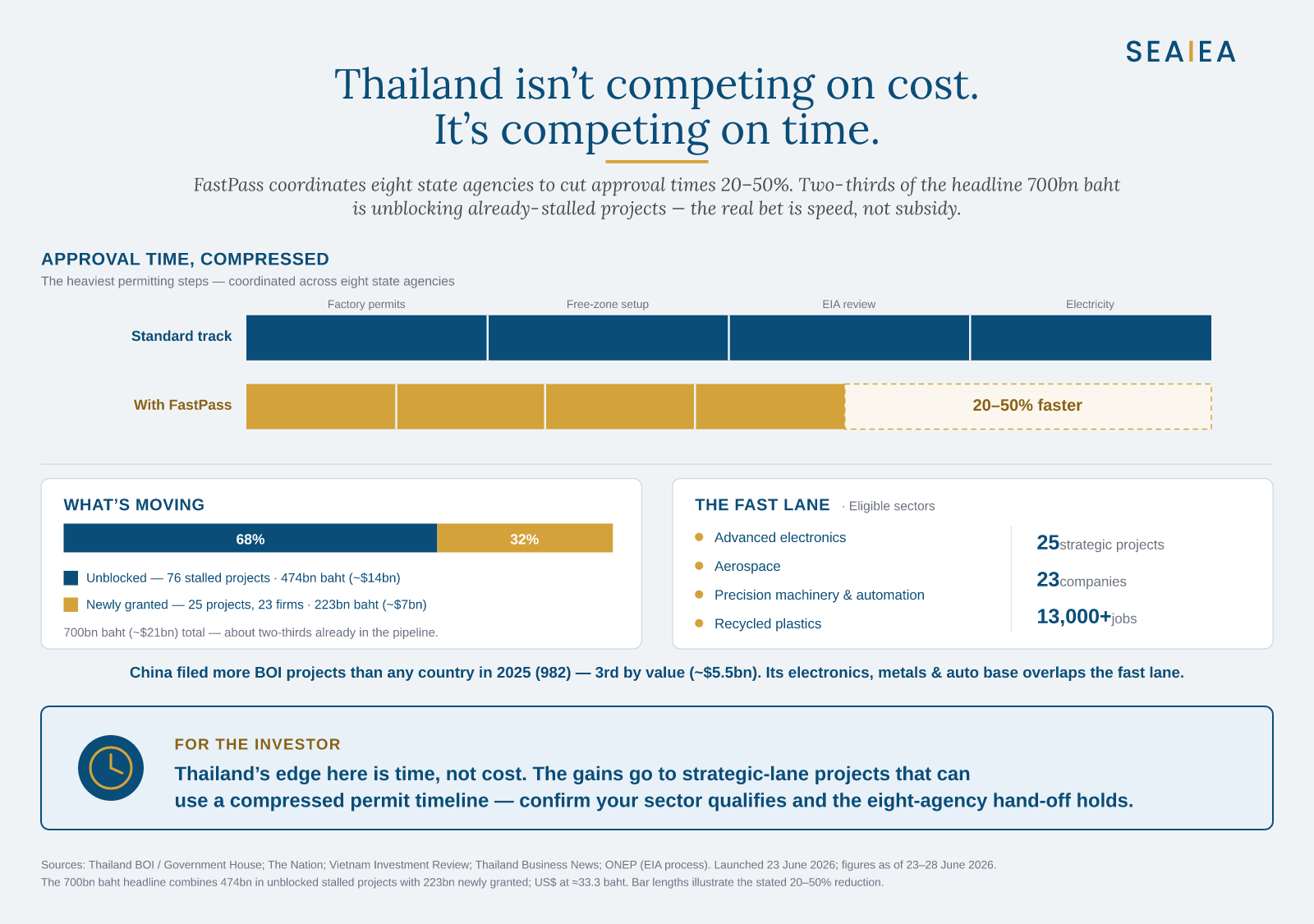
Thailand's FastPass doesn't cut tax — it cuts approval time 20–50% across eight agencies. The edge is speed, and it accrues to strategic-lane projects.

On 23 June, Prime Minister Anutin Charnvirakul stood up at Government House and launched FastPass — an attempt to shorten the time it takes to turn an approved investment into a working factory. It bundles the eight agencies a major project has to clear — the Board of Investment (BOI), industrial licensing, customs, the environmental regulator and the three electricity authorities among them — and puts them under shared service-level deadlines. The goal is to cut that timeline by 20 to 50 percent, and to guarantee that a plant can actually draw power once it is built. Projects of at least one billion baht in semiconductors, electric vehicles, advanced electronics and digital industries qualify.
If that list sounds familiar, it should. Thailand’s recent investment boom has been closely tied to the expansion of regional manufacturing supply chains, particularly in electric vehicles, electronics, and related industries. Chinese EV brands accounted for roughly 88 percent of Thailand’s electric-vehicle sales in 2025; BYD alone holds close to 40 percent of the battery-EV market and operates a 32-billion-baht ($900 million) plant in Rayong. Chinese automakers have invested more than $3 billion in the country, while industrial-estate take-up in the Eastern Economic Corridor has surged to nearly three times its 2019 level. A significant share of the projects FastPass is intended to accelerate are linked to this broader wave of manufacturing investment. This is not an abstract administrative reform—it directly affects the types of factories and industrial projects now driving much of Thailand’s economic expansion.
And interest was never Thailand's problem. BOI applications hit a record US$54.5 billion in 2025, and another US$30.3 billion in the first quarter of 2026 alone. The bottleneck sat one step later: somewhere between 70 and 74 projects worth more than 300 billion baht, approved in 2023 and 2024, had simply stalled at the permitting stage. The EEC — Chachoengsao, Chonburi and Rayong — now holds more than 70 percent of the country's new semiconductor pledges. But a pledge is not a factory. Until the permits move, all of it is paper.
There is a structural reason the pledges keep coming. On 24 June, the Bank of Thailand held its policy rate at 1 percent and lifted its 2026 growth forecast to 2.3 percent from 1.5 — crediting, in its own words, the "Tech and AI cycle." That is the central bank telling you where the growth actually sits: in electronics and data-centre-linked exports, the very segment Chinese capital has been building out. The upswing is real, but it is narrow — and it runs straight through the projects FastPass is built to serve.
So the interest is structural — and so, unfortunately, is the friction. The Thailand Development Research Institute found that 85 percent of the licensing procedures it reviewed could be cut or amended. The compliance burden, by its reckoning, costs the private sector around 134 billion baht a year — roughly 0.8 percent of GDP. The government does not dispute it; a spokesperson conceded that "regulations intended to guide have, in practice, become costs." FastPass is one front of a wider campaign: an overhaul of up to 7,000 business rules, a "super licence" to merge permits, a "regulatory guillotine" to cut dead ones — an explicit attempt to turn the state from regulator into facilitator.
This has become urgent for a reason beyond ambition. The OECD's global minimum tax has neutralised the tax-holiday edge Thailand long dangled in front of large multinationals; below a 15 percent effective rate, the saving is simply clawed back elsewhere. And Thailand cannot win on cost: its wages run about 25 percent below China's, but Vietnam's run 64 percent below. Strip away tax and wages, and execution speed is the only lever left.
Investors should note that reform in Thailand moves by consensus, negotiated across ministries, agencies and provincial authorities. A clear direction is the beginning of that process, not the end of it. For now, FastPass reorganises the red tape; it does not abolish it overnight. Yet the significance of the initiative lies less in the specific deadlines than in what it signals. Thailand’s challenge is no longer attracting investment.
The country continues to generate record levels of interest from manufacturers seeking a regional production base. The challenge is converting approvals into operating assets before competing destinations do the same. The opportunity is genuine and worth positioning for early — but position, don't sprint.
Get The Weekly Read every week
ASEAN investment commentary, free to subscribers.